
Monday, August 25, 2025

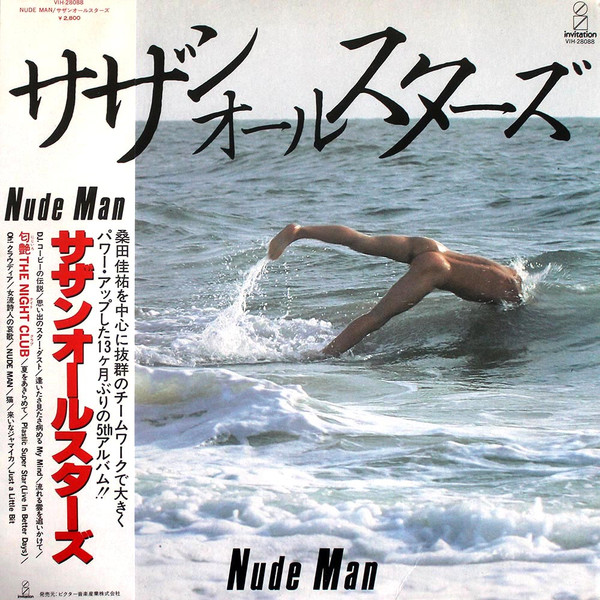
Nude Man by Southern All Stars - 1982


Whenever I talk to Japanese tourists about Shōwa-era music, one band name comes up constantly: Sazan—better known by their full name, Southern All Stars. Led by the charismatic Keisuke Kuwata(桑田佳祐), this Kanagawa-based rock band crafted a unique identity rooted in American rock & roll, Latin music, and highly suggestive lyrics. Arguably, their most famous song is their breakthrough debut single, “Katte ni Sindbad”, which shot into the Top 10 upon its release in 1978.

Their fifth original album, "NUDE MAN," released on July 21, 1982, is considered a landmark album, highlighting their musical evolution. One of the key players in the album's production was Keyboardist Yoshihiro Kunimoto, who played a major role in Sazan's live concerts. Surprisingly, this period also marked the band’s growing interest in songs with socially conscious themes. Despite the album's funky, upbeat sound, some tracks drew inspiration from contemporary issues such as the plight of Japanese war orphans left behind in China and the political scandal of the Lockheed bribery case.

So... we gotta address the naked elephant in the room, and talk about the jacket photo on the album. Captured by photographer Katsuo Hanzawa, it's an image of an Australian hippie with whom Hanzawa lived in a rented fishing hut during a photography trip to India in the early 1970s, encapsulating a sense of freedom and cultural exploration that was synonymous with the band. Kuwata, for whatever reason, found the photograph resonant and amusing, deciding to incorporate it into the album's visual identity with Hanzawa's consent. 

Despite the album's success, lead vocalist Kuwata’s reflections on "NUDE MAN" were mixed. He described the album as "boring" and expressed a lukewarm sentiment towards some of the songs. Yet, he also acknowledged the creative liberation the album afforded him, stating that it allowed him to pursue musical endeavors that were previously out of reach. Kuwata also recognized the album's pivotal role in shaping the band’s image, suggesting that it solidified the Southern All Stars’ identity as synonymous with summer, for better or worse. 

THE MUSIC

  1. Oh! Claudia⭐⭐⭐⭐
  2. The Legend of DJ Kobe (D.J.コービーの伝説) ⭐⭐⭐⭐
  3. Memories of Star Dust (思い出のスター・ダスト)⭐⭐⭐⭐
  4. Giving Up On The Summer (夏をあきらめて)⭐⭐⭐⭐⭐
  5. Chasing the Flowing Clouds (流れる雲を追いかけて)⭐⭐⭐⭐⭐
  6. Rainbow Coloured The Night Club 匂艶The Night Club ⭐⭐⭐⭐⭐
  7. "I've met you, I've seen you, my sick mind" 逢いたさ見たさ病める My Mind⭐⭐⭐⭐
  8. Plastic Super Star (Live In Better Days)⭐⭐⭐⭐⭐
  9. Lamentations of a Female Poet 女流詩人の哀歌⭐⭐⭐⭐⭐
  10. Nude Man ⭐⭐⭐⭐
  11. Cat 猫⭐⭐⭐
  12. Come Jamaica 来いなジャマイカ⭐⭐⭐⭐
  13. Just A Little Bit⭐⭐⭐⭐⭐

THE VERDICT 


When it comes to summer pop in Japan, names like Tube or Omega Tribe are usually the first to surface. Omega Tribe and Southern All Stars (SAS), in many ways, are the premier summer bands; however, their differences are perfectly articulated by prolific songwriter & producer Tetsuji Hayashi:

“If Southern All Stars is a beach house, then Omega Tribe is a bistro. The former can go anywhere in the country, even if there is a curtain of ice. But the latter is pretty much restricted to Shōnan or Suma. That’s where SAS’s strength lies.”

Where Omega Tribe is bound to a single, summer vibe, SAS thrives on flexibility, which allows them to remain fresh long after the season fades. Their 1982 album Nude Man embodies this versatility—a strange yet addictive collage of Southern rock, disco, 1960s soul, and Latin influences, all anchored by Keisuke Kuwata’s bluesy, soulful vocals.

One of the album’s standouts, “Natsu o Akiramete” (夏をあきらめて), has become one of SAS’s most enduring ballads, a breezy anthem of summer love. Remarkably, Kuwata recorded the vocal while suffering from a TMJ disorder—yet it still shines as one of his best performances. “Chasing the Flowing Clouds” (流れる雲を追いかけて) offers a somber honky-tonk ballad telling the story of a mother enduring hardship in war-torn Manchuria. While it's a beautiful song by itself, it's extremely jarring, as it is immediately followed by “Nijiiro The Night Club”, the album’s showstopper: a bombastic, Latin-flavored track brimming with strings, brass, and layered vocals that perfectly encapsulate SAS’s signature sound. Then there’s “Koi na Jamaica” (来いなジャマイカ)—a tongue-in-cheek reggae cut that’s as provocative as it is goofy, with the lyrics cheekily name-dropping Marley, Jagger, and Ray Parker Jr., while rhyming “erection” with “connection.” While each song varies in tone, you can tell that they were constantly looking for new ways to go all-out in the studio, Plastic Super Star being the perfect example, as it's produced to sound like a live concert, Kuwata went so far as to invite dozens of students from Aoyama Gakuin University, his old stomping grounds, to serve as the rowdy audience.

Listening to Nude Man is like wandering through a raucous summer festival: eclectic, noisy, a little messy, but utterly unforgettable. This record is a testament to Southern All Stars’ ability to pivot between genres while always sounding unmistakably like themselves.

Saturday, August 23, 2025

Blue's by UDAKAN - 1988


The Blues are the cornerstone of American music. Artists like Muddy Waters and B.B. King laid the foundation for what we would eventually call Rock & Roll. Although the genre’s popularity waned over the decades, it experienced a significant revival in the 1980s, carried by the passion and soul of artists such as Stevie Ray Vaughan and Robert Cray.

Color me surprised, then, when I discovered that the Blues also found a new home across the Pacific—in the bustling streets of Osaka. By the 1970s, a thriving underground scene had taken root in the Kansai region, where bands like Funny Company, West Road Blues Band, and Masaki Ueda’s South To South reinterpreted the genre through a distinctly Japanese lens. They didn’t just imitate American forms—they injected their own regional flavor, blending Kansai’s rough-and-ready spirit with the raw emotion of Delta and Chicago blues.

Among these groups, one of the most famous names to emerge was Ukadan (憂歌団). Founded by Mitsuki Kimura (木村充揮) and Kantaro Uchida (内田勘太郎), the band began performing in the early 1970s under the heavy influence of American blues musicians. But unlike many copy bands of the era, Ukadan adapted the blues to the Kansai dialect and daily life. Their performances carried what critics called the “smell of the street,” making their music resonate deeply with ordinary listeners.

The best example is their 1975 debut single “Osōji Obachan” (“Cleaning Lady”)—a satirical take on the life and personality of an Osaka cleaning woman. While catchy and full of swagger, the song was banned from airplay just a week after release, accused of mocking working-class women. Ironically, the controversy only cemented Ukadan’s reputation as a band unafraid to push boundaries.

Over the next decade, their name became synonymous with Japan’s homegrown blues. That reputation reached its peak in June 1988, when Ukadan became the first Japanese band ever to perform at the Chicago Blues Festival, standing shoulder to shoulder with the music’s originators. That same year, they released their most iconic album, simply titled “BLUE’S”. Produced by famed lyricist Chinfa Kan, this record confirmed their place not just in Japanese music history, but in the global story of the blues.


THE MUSIC


  1. 大阪ビッグ・リバー・ブルース⭐⭐⭐⭐⭐
  2. ちっちゃなダイヤモンド / Little Diamond⭐⭐⭐⭐⭐
  3. 二人でいようよ/ Let's be together ⭐⭐⭐⭐
  4. かぞえきれない雨⭐⭐⭐⭐⭐
  5. 働け、ブルース・バンド⭐⭐⭐⭐
  6. 木綿のシャツをつくっておくれ / Make me a cotton shirt⭐⭐⭐⭐
  7. オンリー・ロンリー・ジャマイカ⭐⭐⭐⭐
  8. Fisherman's Blues⭐⭐⭐
  9. Angel On My Shoulder⭐⭐⭐⭐⭐
  10. とどかぬ想い~I Say Love You, Only~⭐⭐⭐⭐⭐

THE VERDICT


I wasn’t sure what I expected going into this one. The opening track, “Osaka Big River Blues,” immediately reminded me of Masaki Ueda’s signature ballad, “Osaka Bay Blues.” Honestly? It’s just as good. Something about Kimura’s raspy vocals evokes the grit of Howlin’ Wolf or Joe Cocker, perfectly matching the band’s down-to-earth style.

Songs like “Little Diamond” use the metaphor of a diamond to describe the precious, irreplaceable things we hold in our daily lives. That kind of lyricism, paired with Ukadan’s gritty blues-rock instrumentation, shows their intimate understanding of what the blues is really about—turning ordinary struggle and longing into something universal.

“Countless Rain” (かぞえきれない雨) is another standout, a deeply evocative blues ballad that channels heartbreak and isolation through weather imagery. The rain becomes a relentless force, pounding at the narrator’s heart like unshakable sorrow. Pair that with a lonely highway at night, and you’ve got a song that hits as both raw poetry and a badass driving soundtrack.

Funny enough, with most J-rock bands I encounter, this album veers into other genres with equal quality. “Let’s Be Together” (二人でいようよ) drifts into a light, breezy bossa nova, the kind of track you’d hear in a quiet coffeehouse. Meanwhile, “Make Me a Cotton Shirt” (木綿のシャツをつくっておくれ) plays like a jazz standard lifted straight from the Great American Songbook, warm and timeless.

That’s what makes diving into albums like this so rewarding: discovering the many ways American music gets reinterpreted through the lens of another culture. Ukadan don’t just cover the blues—they live it, while bending its vocabulary into something distinctly their own.

Saturday, August 16, 2025

Windless Blue by Kaze - 1976


It wasn’t unusual in the 70s for American folk and rock acts to pivot into softer rock and AOR. The same shift was taking place in Japan, a prime example being the folk duo Kaze(風), formed by Shōzō Ise (伊勢正三) and Kazuhisa Ōkubo (大久保一久). They debuted in 1975 with “22-Year-Old Farewell” (22才の別れ), a heartfelt reworking of a song Ise had originally written during his tenure with the folk trio Kaguyahime.
With their first two albums, Kaze quickly established themselves in Japan’s booming folk-pop scene, guided by the steady hand of arranger Ichizō Seo (瀬尾一三), who shaped much of their early material. But by the mid-70s, both Seo and Ise had fallen under the spell of American AOR — sleek, urbane sounds pioneered by artists like Boz Scaggs, Orleans, and Steely Dan. This influence pushed the group to broaden their sonic palette and aim for a more polished, contemporary sound.
The result was WINDLESS BLUE, released in November 1976. Returning as producer and arranger, Seo surrounded the duo with top-tier talent: jazz saxophonist Takeru Muraoka (村岡健), prolific percussionist Nobu Saito (斉藤信男), and pianist Kentaro Haneda (羽田健太郎), who would later gain acclaim for his anime soundtrack work.


THE MUSIC 

  1. The Woman Who Rests Her Chin in Her Hand (ほおづえをつく女/Hoozue o Tsuku Onna) ⭐⭐⭐⭐

  2. Highway at Night (夜の国道 / Yoru no kokudō) ⭐⭐⭐⭐⭐

  3. Turn Left on Route 3 (3号線を左に折れ / 3-Gōsen o hidari ni ore) ⭐⭐⭐

  4. An Afternoon on the Journey (旅の午後 / Tabi no gogo) ⭐⭐⭐⭐

  5. Passing Shower (通り雨 / Tōriame) ⭐⭐⭐⭐⭐

  6. Afternoon Street 25 (アフターヌーン通り25 / アフターヌーン通り25) ⭐⭐⭐⭐

  7. Small Hands (小さな手 / Chīsana te) ⭐⭐⭐⭐

  8. The Town Where You Can See the Horizon (地平線の見える街 / Chiheisen no mieru machi) ⭐⭐⭐⭐

  9. The Youth I Walked with You (君と歩いた青春 / Kimitoaruitaseishun) ⭐⭐⭐

  10. Before I Realized It (ふっと気がつきゃ / Futto kigatsukya) ⭐⭐⭐⭐

  11. Just a Little Baggage (少しだけの荷物 / Sukoshidake no nimotsu) ⭐⭐⭐


THE VERDICT


Listening to Windless Blue feels like stumbling across a long-lost Seals & Crofts record. Tracks like “Hoozue o Tsuku Onna” (The Woman Who Rests Her Chin in Her Hand) and “Tōriame” (Passing Shower) highlight Kaze’s knack for weaving West Coast–style soft rock into the fabric of Japanese folk. The album’s crown jewel is easily “Yoru no Kokudō” (Highway at Night). Its groovy mid-tempo pulse and rich vocal harmonies evoke the unmistakable mood of a nighttime coastal drive — windows down, salt air rolling in, headlights stretching endlessly down the highway. You can play this track right alongside "Babylon Sisters" by Steely Dan and not bat an eye. While your average American listener might not immediately connect folk music to the emergence of City Pop, Windless Blue makes the case effortlessly. Its breezy, sophisticated arrangements mark a clear turning point in the mid-70s, pushing Kaze beyond their folk-pop beginnings and into a more refined, urban soundscape.


Friday, August 15, 2025

Downtown by EPO - 1980


Back in 1975, a band called Sugar Babe, featuring Tatsurō Yamashita, Taeko Ōnuki, and Kunio Muramatsu, released an album simply titled SONGS. Though it would later be hailed as a turning point in Japanese pop and serve as ground zero for the City Pop genre, the album initially flopped. Within a year, Sugar Babe had disbanded.

Fast forward to 1978 in a small café in Mishuku, Setagaya. RCA producer Shigeki Miyata meets an aspiring singer-songwriter named Eiko Satō (佐藤栄子). She went by her childhood nickname, EPO, a moniker that stuck ever since a tongue-twisted “Eko-chan”(えーこちゃん) came out as “Epo-chan”(エポ ちゃん). EPO and Miyata talked for hours about her love for Sugar Babe. That conversation convinced Miyata they should make an album together, planting the seed for EPO’s debut, Down Town.

At RCA, EPO was promoted as “the next Mariya Takeuchi”, part of the so-called “Three Daughters of RCA” alongside Ōnuki and Takeuchi herself. During her debut, EPO described her style as “Yellow Pop”—a unique hybrid that was neither rock nor kayōkyoku (traditional Japanese pop). Much like Sugar Babe, she sought to carve out her own space in Japanese music. Many songs on Down Town came directly from her notebooks, including compositions written in high school and lyrics inspired by her personal experiences. The album was produced by Miyata, with arrangements by Tetsuji Hayashi and Nobuyuki Shimizu. The backing chorus featured a remarkable lineup of RCA peers—Yamashita, Ōnuki, and Takeuchi—bringing EPO full circle to Sugar Babe's legacy.

Released on March 21, 1980, Down Town was accompanied by the titular single, which became her signature song, cemented when Fuji TV adopted it as the ending theme for the wildly popular variety show Oretachi Hyōkin-zoku, starring comedian & actor Beat Takeshi.


THE MUSIC


  1. Down Town ⭐⭐⭐⭐⭐
  2. Yakusoko Ha Ame No Naka (約束は雨の中)⭐⭐⭐⭐
  3.  Klaxon ⭐⭐⭐⭐
  4. Nichiyo Wa Bell Ga Narumaeni (日曜はベルが鳴る前に) ⭐⭐⭐⭐⭐
  5. Katarai (語愛) ⭐⭐⭐ 
  6. Pop Music Suite⭐⭐⭐⭐
  7. Asphalt・Hitori (アスファルト・ひとり)⭐⭐⭐⭐⭐
  8. Iiwake Wa Shinaikedo (言い訳はしないけど)⭐⭐⭐
  9. Suiheisen Oikakete (水平線追いかけて)⭐⭐⭐⭐
  10. Caffe Time ⭐⭐⭐


THE VERDICT


I’ll be honest—it took a while for this album to grow on me. When I first heard EPO’s rendition of "Down Town", I brushed it off as little more than a karaoke imitation of Sugar Babe’s original. But over time—especially after buying the vinyl—it crept into my head and became an earworm I couldn’t shake. What eventually won me over was the pairing of its minimalist, synthpop-inspired arrangement with EPO’s jazzy, cheerful voice. 

It's impossible not to get cheery while listening to this record. Tracks like "Yakusoku wa Ame no Naka" and "Suiheisen Oikakete" carry a bouncy, peppy energy that flows effortlessly from one song to the next, and EPO’s singing is a big part of what keeps that momentum alive. It’s easy to hear shades of Mariya Takeuchi in her vocal style, but EPO brings a little more swing that makes Down Town feel more like its own unique experience. "Asphalt Hitori"  is the real unsung hero on this album, continuing the time-honored City Pop tradition of being a near celebratory-sounding disco track with lyrics about loneliness, complete with infectious vocal harmonies and beautiful string arrangements.
Down Town is probably the most prototypical City Pop record you can think of, yet cements itself as a seminal album in its legacy, and proof that sometimes you really can reinvent the wheel. It’s a fun, spirited debut that firmly established EPO’s signature perky, energetic sound, which she would refine further on her follow-up, Goodies. Blending the genre’s 70s roots with the 80s sparkle & sheen, Down Town is both a great intro to City Pop and an endearing showcase of EPO’s charm.

Thursday, August 7, 2025

Baby Blue by Ginji Ito (1982)


After the commercial failure of his 1977 debut album, Deadly Drive, Ginji Ito (伊藤銀次) spent the next five years carving out a place in the music industry behind the scenes, writing and arranging songs for other artists to make ends meet. His fortunes began to shift in the early ’80s when he was invited to join the live backing band for Miki Matsubara’s performance of her breakout hit, Stay With Me.

It was during this period that Ito crossed paths with rising singer-songwriter Motoharu Sano. Their connection led to Ito arranging songs for Sano’s debut album, Back to the Street. His work on the record caught the attention of music director Kenji Kizaki, who soon enlisted Ito to arrange music for pop idol Kenji Sawada.

While working on Sawada’s 1981 album Stripper, Ito’s vocal talent unexpectedly came to light—thanks to a demo tape he recorded for one of the songs. Impressed, Director Kizaki encouraged Ito to step back into the spotlight. With his support, Ito began work on what would become his long-awaited comeback album: Baby Blue.


THE MUSIC

  1. Baby Blue  ⭐⭐⭐⭐⭐
  2. Stella (Rainy Stella / 雨のステラ) ⭐⭐⭐⭐
  3. Tappin’ and Clappin’ ⭐⭐⭐⭐⭐
  4. Planet Girl ⭐⭐⭐⭐
  5. Same Old Song (センチメンタルにやってくれ) ⭐⭐⭐⭐
  6. Congratulations (3:38)⭐⭐⭐
  7. One Way Ticket To The Moon (3:51)⭐⭐⭐⭐⭐
  8. Because Of You (3:37) ⭐⭐⭐⭐
  9. Just A Little Love⭐⭐⭐⭐
  10. Shade Of Summer ⭐⭐⭐


THE VERDICT ⭐⭐⭐⭐

After listening to a few of his albums, I’ve come to realize that Ginji Ito isn’t the type of artist to stick to just one style, nothing wrong with that. But I think Baby Blue is proof that he truly shines when performing nostalgic, 60s-style oldies pop. This album feels like it could be kissing cousins with Someday by Motoharu Sano—especially on tracks like “Baby Blue” and “Because of You,” which blend baroque pop melodies with the polished city pop sound of the early 1980s. There’s a romantic wistfulness running through the album that’s hard to shake. Funny enough, my favorite track is actually “One Way Ticket to the Moon”, a smoother, spacey AOR jam that would fit right alongside anything by Paul Davis or Hall & Oates. And shoutout to “Tappin’ & Clappin’” for being one of the goofiest yet catchiest Christmas songs I’ve ever heard. It’s a happy-go-lucky number with a laid-back groove reminiscent of James Taylor’s “How Sweet It Is,” paired with lyrics about a man spotting a woman at the beach who reminds him of a Christmas tree. I don’t know what kind of holiday party Masao Urino was at when he wrote those lyrics, but it must’ve been a blast. Although I think most people consider Deadly Drive as Ginji Ito's most iconic album, I personally believe Baby Blue best highlights his strengths as a singer-songwriter. 

If you want to learn more about Giji Ito, check out his website: https://ginji-ito.com/

FINE! by Yasuko Agawa - 1982


 Yasuko Agawa (阿川泰子), born October 16, 1951, in Kamakura, Kanagawa Prefecture, is a renowned Japanese singer known for her contributions to jazz, J-pop, and radio. Yasuko Agawa studied acting at the prestigious Bungakuza Theatre Research Institute and began her career as an actress, appearing in major Toho films such as The Family Game and The Gate of Youth, as well as popular television dramas including Taiyō ni Hoero! and Ultraman Leo. During her time as an actress, she was introduced to the late jazz clarinetist Shoji Suzuki, whose influence inspired her to pursue a career in jazz. Soon after, she became the exclusive vocalist for Shoji Suzuki and The Rhythm Aces, officially launching her professional career as a jazz singer.

Agawa made her solo debut in 1978 with Love-Bird, an album showcasing her interpretations of American pop standards written by artists such as Melissa Manchester, Stevie Wonder, and Fred E. Ahlert. Over the next several years, she established herself as a premier jazz vocalist in Japan through a series of albums rooted in the Great American Songbook. Her career took a pivotal turn when she traveled to California to record FINE!, her first original album produced in the U.S. The album was backed by the San Francisco-based Brazilian fusion group Viva Brasil, led by Claudio Amaral and Jay Wagner, with arrangements by Masanori Sasaji. The result was a sophisticated blend of Japanese jazz, American fusion, and Brazilian rhythm, solidifying her status as an international jazz talent.


THE MUSIC 

1. Meu Amor ⭐⭐⭐⭐⭐
2. Searching  ⭐⭐⭐⭐
3. Fill Up The Night ⭐⭐⭐⭐
4. New York Afternoon ⭐⭐⭐⭐⭐
5. Darlin' Don't Ever Go Away⭐⭐⭐⭐
6. Smile On Your Face ⭐⭐⭐⭐⭐
7. Jump For Joy⭐⭐⭐
8. You and I ⭐⭐⭐⭐
9. Take A Holiday ⭐⭐⭐
10. Affair of the Heart ⭐⭐⭐⭐


THE VERDICT ⭐⭐⭐⭐

It’s fascinating that Yasuko Agawa chose to sing every track in English for her first album, composed entirely of original material. Remarkably, it works so well, in fact, that you’d be hard-pressed to tell she’s Japanese just by listening. Her soft, elegant vocals and near-flawless English blend seamlessly with the album’s smooth Latin-jazz rhythms. Tracks like “New York Afternoon” and “Meu Amor” instantly transport you to the heart of Spanish Harlem or the glow of 52nd Street. While the album largely stays within the bounds of bossa nova-infused pop, that consistency allows each song to flow naturally into the next, creating a cohesive, mood-driven experience. “Jump for Joy” takes a slight detour into disco territory, but it doesn't disrupt the flow. Fine is a great introduction to Yasuko Agawa’s music—a showcase of her original work that transcends the language barrier with grace and style. 

If you want to learn more about Yasuko Agawa, check out her Website: https://www.agawa.jp/discography.html

Downtown by EPO - 1980

Back in 1975, a band called Sugar Babe , featuring Tatsurō Yamashita , Taeko Ōnuki , and Kunio Muramatsu , released an album simply titled S...