
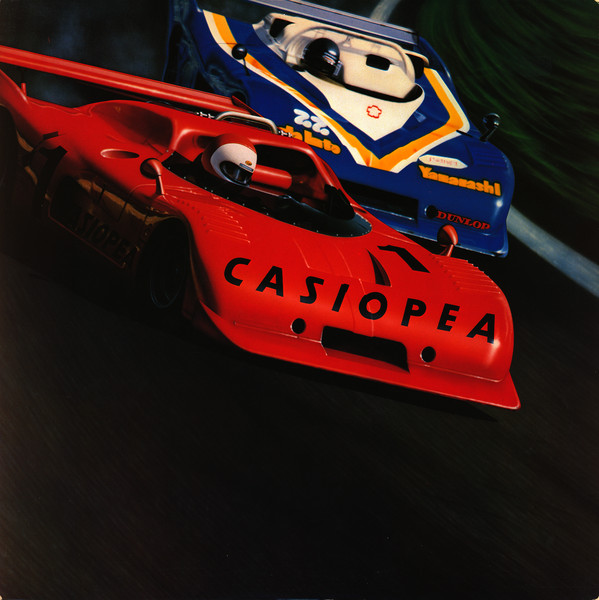
When you bring up Japanese jazz fusion, the first name that usually comes to mind is Casiopea—and for damn good reason. Formed in 1976 by guitarist Issei Noro (野呂一生), Casiopea has been a cornerstone of Japan’s jazz-fusion scene for nearly five decades. Noro, initially a Beatles fan, soon gravitated toward fusion greats like Larry Carlton and Lee Ritenour. After studying at Musashino Music Academy, he quickly established himself in Tokyo’s live circuit. As Casiopea’s founder, principal composer, and leader, Noro’s clean, technical precision and melodic sensibility became the band’s signature sound.
Casiopea would change The Lineup That Shaped the Debut:
Takashi Sasaki – Drums (佐々木隆)
Born Nov. 8, 1952, in Sendai. Inspired by The Ventures, Sasaki began drumming in junior high before moving to Tokyo, where he worked with Mickey Curtis & The Samurai and Sounds Unlimited. By 1977, he was drumming with Count Buffalo & Jazz Rock Band, gaining recognition in Japan’s fusion scene. He joined Casiopea in 1979.
Tetsuo Sakurai – Bass (桜井哲夫)
Born Nov. 13, 1957, in Tokyo. Sakurai picked up the bass at 16, deeply influenced by Jaco Pastorius and Stanley Clarke. While attending Meiji University, he honed his craft in Tokyo jazz clubs. Known for his aggressive slap technique and melodic phrasing, he quickly became one of Japan’s most exciting young bassists.
Minoru Mukaiya – Keyboards (向谷実)
Born Oct. 20, 1956, in Tokyo. A pianist since age 5, Mukaiya later explored synthesizers and organ while studying architecture in college. His classical foundation blended with a sharp, modern jazz-rock sensibility, giving Casiopea much of its vibrant melodic texture.
Recording the Debut
This lineup would record Casiopea’s self-titled debut album between December 1978 and March 1979. They were joined by American jazz heavyweights Michael Brecker (saxophone), Randy Brecker (flugelhorn), and David Sanborn (alto saxophone), adding international star power to the project.
Every track was written by Noro, with horn arrangements by fusion pioneer Jun Fukamachi and string arrangements by singer-songwriter Hiroki Inui. Released on May 25, 1979 under Alfa Records, the album set a new standard for Japanese fusion—balancing technical precision, smooth melodic interplay, and a distinctly Tokyo flair.
THE MUSIC
|
|---|
THE VERDICT


Casiopea remains one of the cornerstones of Japanese fusion for good reason. Their music is fun, groovy, and endlessly engaging. You can tell that the band spent their formative three years honing a signature style, and when the album finally arrived, it paid off tremendously. Each track feels like its own story, brimming with personality. “Time Limit” pumps your adrenaline like you’re a contestant on a game show with only seconds left on the clock. “Tears of a Star” carries a floating melancholy, as if you’re drifting sorrowfully through the cosmos, only to be hurled into light-speed by the explosive “Space Road.” The most captivating moment might be “Midnight Rendezvous”—a smoky, funky jam that feels like stepping into a seedy casino, ready to gamble your life away.
What elevates Casiopea’s debut above so many peers is its balance of individual brilliance and group synergy. Every instrument—bass, guitar, keys, and drums—gets its moment to shine, often through electrifying solos that spotlight the musicians’ virtuosity without losing the tight groove of the ensemble. For anyone beginning their Japanese jazz-fusion journey, Casiopea (1979) is the perfect starting point. It’s an album that merges the fast-paced funkiness of the Brecker Brothers with the silky guitar finesse of David T. Walker or George Benson, creating a music experience that’s both technically dazzling and irresistibly fun.
If you want to learn more about the history of the band, check out this great video by T2norway


