

There have been many artists to lay claim to the tile of King of their respective genres. Elvis was considered the King of Rock & Roll, James Brown is known as the Godfather of Funk, and of course, Michael Jackson will forever be known as the King of Pop. However, in Japan, the title of King of Pop belonged to another multitalented superstar by the name of Hideki Saijo (西城秀樹). Hideki Saijo (born Tatsuo Kimoto [木本龍雄]), was singer, actor, and television celebrity whose career has lasted from the 70s up until his untimely passing in 2018. He was known as the most popular male idol singer of his time, however, like many artists, at some point in the 80s, he eventually wanted to evolve his musical identity, which brings us to his sixteenth album, Until Twilight...Hideki (トワイライトまで …ヒデキ).
THE HISTORY

Hideki Saijo hoped that a more adult contemporary album would help change his public image as a musician. Even down to the original concept for the album, a mature story about a man hanging in his car at twilight in a lover's quarrel with his girlfriend in the passenger seat. This narrative was recreated in the art for this album, which would be the first not to have his face on the cover, instead, a beautiful pastel illustration by Kazunori Konda(近田和典), who also designed a few of Toshiki Kadomatu's albums.

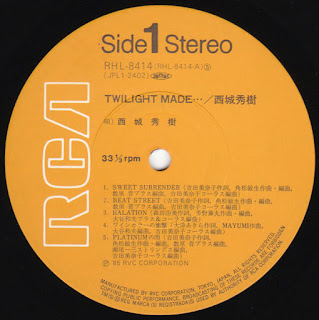
Until Twilight was released on July 21st, 1985. Unfortunately, it did not become a hit, but it did produce a popular single in the form of the song, Beat Sreet, which was released two months after the album's release on September 5th. Even though the album did not succeed as expected, Hideki Saijo continued down the path of City Pop and successfully crafted his own signature AOR sound in his 1986 follow-up, From Tokyo.
THE MUSIC
- Sweet Surrender: ⭐⭐⭐⭐
- A high octane synth-pop track with punchy horns and a lively drum track.
- Beat Street: ⭐⭐⭐⭐⭐
- The second verse same as the first, but this time there's a kickass guitar solo thrown in. Plus Yoshida's backing vocals are given more presence, making the song much livelier.
- Halation:⭐⭐⭐⭐
- A groovy pop-rock tune perfect for cruising down the highway. The highlight of this track is the smooth saxophone solo in the middle.
- ワインカラーの衝撃 ( Watercolor No Shogeki) | Watercolor Impact: ⭐⭐⭐⭐
- A mellower, funkier groove featuring a super reverbed guitar solo.
- Platinumの雨 (Platinum No Ame) | Platinum Rain:⭐⭐⭐
- A pretty typical yacht rock ballad that's given an extra boost thanks to the great string arrangement and Minako Yoshida's warm and breathy backing vocals.
- リアル・タイム | Real-Time:⭐⭐⭐
- A mid-tempo synthpop ballad that features a nice jazzy interlude in the middle of the song.
- オリーブのウェンズディ(Olive No Wednesday) | Wednesday Olive: ⭐⭐⭐⭐
- Another funky dance song about a DJ falling in love. Saijo puts on a voice throughout the song as the DJ tries to sweet-talk a young lady who's obviously rejecting his advances.
- Beautiful Rhapsody: ⭐⭐⭐
- A jazzy upbeat boogie track that really swings.
- Television: ⭐⭐⭐⭐⭐
- The funkiest track on the record, with the best use of bombastic horns, funky guitar riffs, and soulful backing vocals.
- レイク・サイド | Lake Side: ⭐⭐⭐
- Another model slow ballad to close out the record. Complete with an overdramatic piano at the end.

THE VERDICT
.png)

However, this album can sound a bit too familiar. I remember when I first heard this album without knowing who Hideki Saijo was and my initial impression was this was an imitation of After 5 Clash & Gold Digger. Even the track Wednesday Olive feels like a retread of Secret Lover. Of course, that doesn't mean the songs are bad, they just lack an identity of their own.


